Why Am I Not Getting Interviews?
August 31, 2026
There's a specific kind of frustrating that's different from total silence. You're not hearing nothing, you're getting the occasional reply, a form rejection, maybe even a recruiter screen that goes nowhere. But an actual interview invite, the kind where a hiring manager wants to talk to you, never comes. If that's your situation, the fix is different from what fixes zero responses, because the problem is happening at a later stage.
A response and an interview are different signals
A resume goes through roughly two filters before an interview happens. The first is automated or semi-automated: does the resume parse cleanly and match enough of the posting's keywords to clear an ATS threshold or catch a recruiter's first scan. The second is a human actually reading it and deciding it's worth a conversation. If you're getting responses, even rejections, you're generally clearing the first filter. That means the usual advice about fixing keywords and formatting, the most common cause of zero responses at all, isn't your bottleneck. Something is happening at the second filter instead.
What actually predicts interview conversion, not just ATS pass
ResuMakeAi's resume score doesn't collapse everything into one number. It breaks a resume down across four categories: formatting and parseability, keyword relevance, quantified impact, and clarity. The first two are almost entirely about clearing the automated filter, whether the document parses and whether it contains the right terms. The second two, quantified impact and clarity, are about what happens once a person is actually reading it. A resume can score well on keywords and formatting and still score weakly on those, and that combination matches this exact symptom: you get through, but you don't convert.
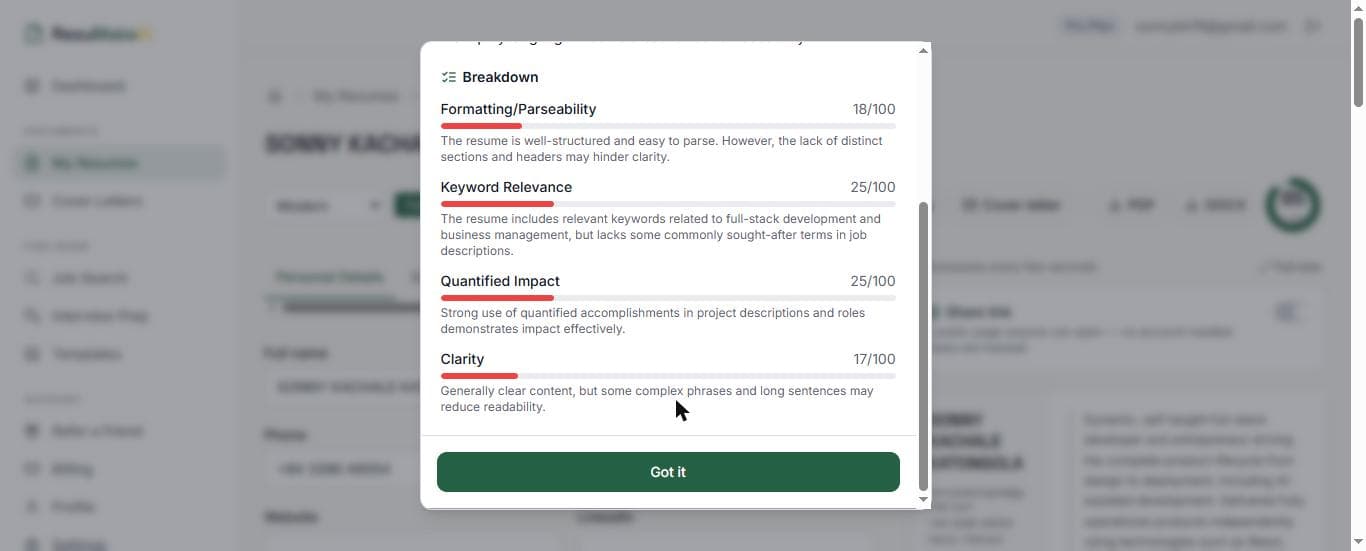
A real score breakdown from ResuMakeAi, not a mockup. Note how Keyword Relevance and Quantified Impact are scored independently, they can (and often do) diverge.
Quantified impact: the gap between “did the job” and “did it well”
Every candidate who gets an interview screen was, on paper, qualified enough to be worth a look. What separates the ones who get invited further is usually evidence that they were good at the job, not just present for it. A bullet that describes a responsibility without a result gives a hiring manager nothing to evaluate.
Before
Handled customer escalations and worked with the support team to resolve issues.
After
Resolved an average of 35 escalated tickets a week, cutting average resolution time from 3 days to 9 hours by building a triage system the support team still uses.
Both versions would likely score similarly on keyword relevance if “customer escalations” and “support” are in the posting. Only the second gives a hiring manager a reason to pick this resume out of a stack of otherwise-qualified ones. That's the difference between clearing a filter and earning a conversation. The opening verb is part of that fix too, see resume power words that actually help for a real action verb bank organized by what you actually did.
Clarity: a resume that parses fine but reads confusingly to a person
An ATS doesn't care whether your career narrative makes sense. A person does. Clarity problems don't block parsing, so they don't show up as a formatting issue, but they slow a reviewer down or leave them with an unclear picture of your actual level, and a confused reviewer moves to the next resume rather than working to resolve the confusion themselves.
Inconsistent seniority signals
A resume that lists “Senior” in one job title and then describes entirely individual-contributor work under it, with no mention of scope, ownership, or people managed, reads as ambiguous rather than impressive. If the title doesn't match the content, a reviewer has to guess which one is accurate, and the guess usually isn't in your favor.
Unclear scope of ownership
“Contributed to a redesign of the checkout flow” could mean you owned the project or that you were one of fifteen people loosely involved. A hiring manager screening quickly won't assume the more impressive read, so unspecified scope usually gets interpreted as the smaller version by default.
Before
Contributed to a redesign of the checkout flow to improve conversion.
After
Led the redesign of the checkout flow end to end, from initial research through launch, increasing conversion by 12% across a 3-person engineering team.
Differentiation: clearing the bar isn't the same as standing out
For most roles that get real applicant volume, dozens of resumes clear the basic bar of “qualified.” An interview invite goes to the ones that look like the strongest version of qualified, not merely an acceptable one. If your resume is technically correct but structurally identical to what every other applicant with your job title would submit, unquantified duties, generic phrasing, no clear scope, there's nothing pulling you above the others clearing the same bar. This is exactly what the quantified impact and clarity fixes above are for: they're not about becoming more qualified, they're about making the qualification you already have legible and specific enough to be the version a reviewer remembers.
Application timing: when you apply changes who reviews you
This one isn't about the resume at all, and it's worth ruling out before you rewrite anything. Many roles get the bulk of their applicant volume in the first 48 to 72 hours after posting, and recruiters commonly work through that backlog roughly in order. A strong resume submitted on day nine of a role that filled its shortlist by day four may never get a real read, not because it was rejected, but because it arrived after the active review window closed. If you're seeing this pattern specifically on roles you apply to late, the fix is applying earlier, not rewriting bullets that were never actually evaluated.
How to tell which stage you're actually stuck at
The practical way to diagnose this rather than guess: check your resume's score breakdown, not just the single number. If keyword relevance and formatting are already strong but quantified impact or clarity are the weak categories, that lines up with getting responses but not interviews, and the fix is rewriting specific bullets for result and scope, not adding more keywords.
- Strong keyword relevance, weak quantified impact: bullets describe duties without results
- Strong keyword relevance, weak clarity: scope and seniority read as ambiguous
- All four categories genuinely strong, but no interviews: check application timing before rewriting further
The resume optimizer is built for exactly this stage of the problem: it rewrites the specific sentences that are vague or unquantified, using the numbers and scope you actually provide, rather than restructuring the whole resume or chasing more keywords. If you haven't checked where your resume currently stands, the free ATS checker shows the full score breakdown against a real job description in one scan.
FAQ
Is getting rejection emails actually a good sign?
It's a better sign than total silence. A rejection means a human or system engaged with the application rather than filtering it out immediately, which points the problem toward conversion quality rather than keyword or formatting mismatch.
Should I add more keywords if I'm already getting responses?
Probably not as the first move. If you're already clearing initial screens, more keywords won't address a conversion problem happening at the human-review stage, quantified impact and clarity are the more likely fix.
How many applications should I send before assuming it's the resume and not bad luck?
There's no fixed number, but a consistent pattern (responses without interview invites across ten or more applications to similar roles) is enough signal to check the score breakdown rather than keep applying unchanged.